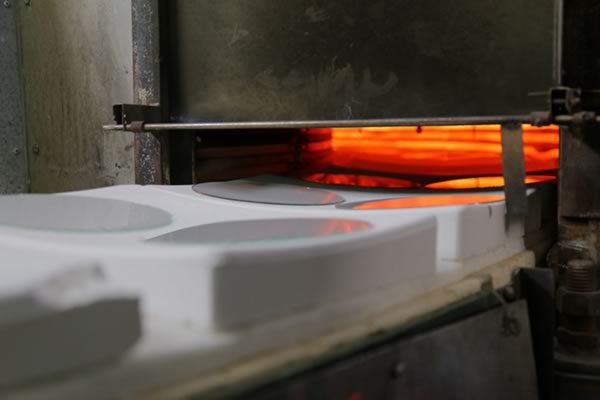
On the line, you don’t want to be second-guessing the lamp in your curved glass heating furnace. Door opens, mold goes in—the lamp has to deliver repeatable heat, fast. If the thermal field lags or drifts, you’re staring down optical distortion, edge stress, and parts that don’t pass inspection. That scrap doesn’t just eat margin; it eats cycle time. Here’s what matters under the hood. We run short-wave quartz elements to cut response time and tighten temperature control. The ramp from ambient to 700°C happens in under 12 seconds, and you get ±3°C uniformity across the active zone. Power density is tuned at 35–45 W/cm², enough flux to do the job without creating hot spots that push thermal stress into thin glass or complex bends. The lamp body is built for the floor: quartz envelope, terminals sized for 240 V/480 V service, and a footprint that drops right into the existing furnace reflector geometry. On a curved glass line, the heat profile is the difference between shape repeatability and a pile of rejects. This lamp keeps the heating curve stable, so the glass hits target viscosity quickly and evenly. You see fewer reworks, consistent sag control, and a higher first-pass yield. Energy use drops because the short heat-up window keeps furnace off-time down, and the fast recovery keeps the line moving when you switch batches. The same control helps in lamination prep and coating drying, where limiting overheat and convection turbulence cuts pinholes and haze. Installation is straightforward, but match the lamp to the furnace controller’s emissivity and zone logic. If you don’t, you’ll fight overshoot. Check mounting clearance and reflector alignment—small gaps can throw off uniformity. Under steady cycling, expect 5,000+ hours of service life. During peak production, keep spare lamps on hand so an unplanned outage doesn’t stop the line.